blue cape

blue cape

Sunday, January 24, 2016

The Three D's: Distraction

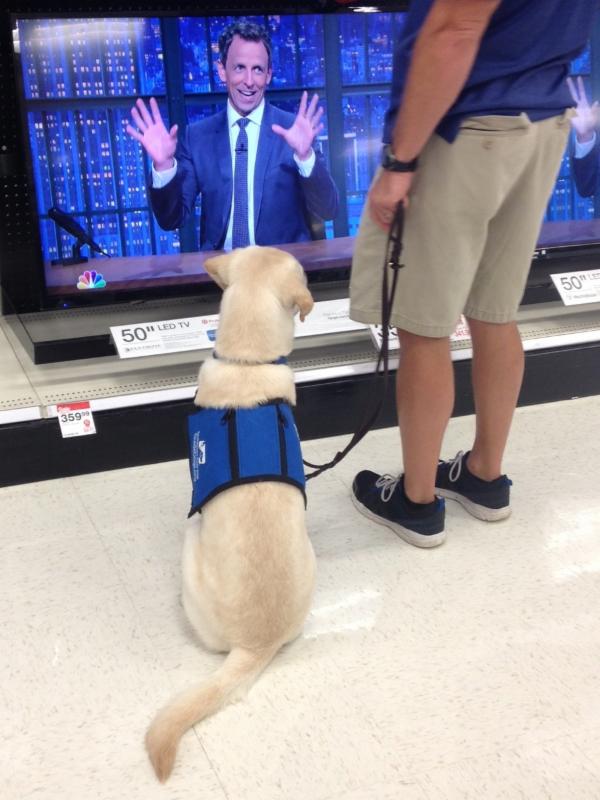
Our final topic in the 3Ds series is DISTRACTION. In general, distraction is probably the number one behavioral issue that puppy raisers ask about. Every dog has something that acts as a distraction, although it can be different for each dog. A distraction is something that attracts your puppy’s attention. Some examples of high distractions are small animals like birds or squirrels, other dogs, people, and moving items like trash or leaves blowing.

Why is it important to work on distraction?
Regardless of what is most distracting for your pup, as a guide or service dog, she will encounter those distractions in the “real world.” It’s important that you help your pup learn how to ignore those distractions as a young puppy so she can do the same as a working dog and maintain focus.

How do you work on distraction?
Of course, keep in mind that when focusing on one of the 3Ds (distraction), you will want to adjust the other 3Ds (distance and duration) to help make your pup successful!
  1. Begin with low level distractions for your puppy and gradually increase to high level distractions, over time. Because each pup is distracted in varying degrees to each stimulus, know what is “low level” vs. “high level” for your pup. Watch your pup’s body language if you are uncertain.
  2. Ask your puppy for skills she knows well while the distraction is present. Don’t forget to cut your duration by half or more for the obedience skills. Being successful is important to help the dog advance her skills, so easy obedience is best first. Make sure to use BOTH hand and verbal skills to add support for your pup and to make it clear for which command you are asking.
  3. Reward behavior that you want! If your pup obeys your command, sits on her own without lunging towards the distraction, responds to her name, or even chooses to look at you over the distraction, REWARD with a treat and praise! With a distraction present, its very difficult for your puppy and you want to focus on making it a great thing to work with you.
  4. Build on distraction as your pup shows she can stay connected with you. If your pup can do obedience with a low level distraction today, try a mid level distraction tomorrow. Or you can choose to work on another of the 3Ds while keeping the distraction at a low level – such as moving slightly closer and decreasing distance. 

Recently we worked with a raiser and her dog for dog distraction. The raiser reported that she often has a difficult time walking past other dogs, especially in class or public. While at the hardware store with another raiser team, we practiced working on distraction.

In the first clip, you will see what the raiser reports it normally looks like when she and her pup walk by other dogs. However, in the second clip, you will see that we changed several things to help the team be more successful:
  • Increased DISTANCE away from the other dog.
  • Decreased DURATION for loose leash walking – the raiser only walks several steps before stopping and asking the dog for a ‘sit.’
  • The raiser increases the rate of reinforcement – both treat rewards AND praise!
  • While not everything looks “perfect” in the second clip, its good to note that the raiser had one demo by Carrie and then did this excellent job on her first try!

Troubleshooting
  •  My dog can do a “sit” at home, but he can’t do it at the new store we just walked into, even though I don’t see any distractions around! Sometimes you have to be creative about what the distraction really is in a situation. For example, if you go to a new place, the new environment, itself, can be the distraction. In this case, make sure you don’t expect too long of duration or distance from your pup with his commands. Not taking the new environment into account as your distraction is usually the explanation!
  • My dog is distracted by things that move or animals that run away, so I can never seem to get much practice in! If your dog reacts to leaves that blow in the wind, you can tie some leaves to a spool of thread and have someone move the leaves around. You can also do this same type of set up if your dog reacts to very small creatures like bugs or lizards by tying a fake lizard or bug to thread. If your dog is distracted by small animals, you can practice distraction in a pet store, starting at a far distance and decreasing this length as your pup gets more responsive to you in the presence of the small animals.
  • I do set ups, but my dog seems to know when I’m doing them. Doing set ups with what distracts your pup will help both the pup AND you to get the muscle memory about how to react when you see the distraction in real life. The key is that you need a variety of locations where you practice set ups!  You can even have someone walk ahead of you and set something up on one of your daily routes, such as bringing the leaves tied to thread and putting them in the middle of the sidewalk while they stand off to the side.

 Advancing Your Dog’s Skills with the 3Ds
 So, now that you’ve worked on each of the 3Ds, individually, its time to amp it up for your pup! As your pup starts to become more and more responsive to the variations of the 3Ds that you work on, you can begin to combine several of the 3Ds to make it more challenging for your pup. For example, if you had only been working on high level DISTRACTION at a far DISTANCE, start to decrease the distance with the high level distraction. Or if you had been doing a very short DURATION around a high level DISTRACTION, begin to add more duration for behaviors around the high level distractions. The key is to be thoughtful and purposeful while continuing to read your pup’s body language and always asking yourself the important question of, “What do I need to change in this situation to help make my pup successful – distance, distraction, or duration?” By keeping this question always at the forefront of your mind, you will be able to help your pup reach her full potential!

Friday, December 18, 2015

The Three D's: Distance

Continuing our series about the Three D’s (3D’s), this month’s focus is DISTANCE. When advancing your pup’s distance, there are several aspects to focus on to help your pup become more skilled. Distance can refer to the amount of space between you and your pup when working on something like a “stay,” but it’s also the amount of space that, as a team, you have from a distraction, etc.

Why is it important to build distance?
Distance is important because we want our dogs to be able to generalize commands, whether the handler is standing right beside them or is across the room. We also want the dog to be able to remain connected to the handler, despite environmental stimuli.

How do you build distance?
Before we begin, don’t forget the most important rule when working on the 3 D’s -- always make the other 3 D’s (duration, distraction) easier and with lower criteria when working on another of the 3 D’s (distance).

When working on the distance between you and your pup for different commands:
  1. Start with low criteria and from an easy distance where we know the dog can succeed.
  2. Gradually add more distance between you and pup. This will increase the difficulty for the pup.
  3. Continue to add more distance slowly and over time between you and pup. As you increase distance between you and the pup, your pup will typically start to become less responsive, so make sure the pup is responding before creating more distance between you.
  4. Make sure to use your rewards and praise for excellent work! At first, use treat rewards often and with praise, but then move to intermittent rewards, as your dog’s skills progress. When you make the distance more difficult, it will be best to up your rate of reinforcement with treat rewards until your pup is working well at that level. Remember to ALWAYS use praise with and without treat rewards. Praise includes encouraging phrases, smiles, and touch.
Photos: Here we see raiser Stephanie working on distance with pup Century. In the first photo, Stephanie practices with low criteria for her distance. In the second photo, Stephanie has raised her criteria for distance for Century, who shows how he can hold a "sit/stay" from a longer distance.


When working on the distance, together as a team, from a distraction:
  1. Start with low criteria and from an easy distance where we know the pup can succeed.
  2. Ask pup for some obedience or walking on loose leash, parallel to distraction. Dog should be connected to you before asking these behaviors. Make sure to not get closer to the distraction by walking back and forth in a parallel line to the distraction.
  3. If pup is able to work at this distance, then move several steps closer to distraction and repeat. If you notice that pup is losing the connection with you and is starting to become more interested in the distraction, then you are likely at the threshold for your dog and that particular distraction.
  4. Make sure to use your rewards and praise for excellent work! As with distance between you and your pup, initially you should use treat rewards and praise frequently, but move to variable reinforcement, as your dog’s skills progress with working closer to distractions. Remember to ALWAYS use praise with and without treat rewards. Praise includes encouraging phrases, smiles, and touch.
Photos: Century and Stephanie do obedience and walking while working on dog distraction (with stuffed black dog toy). They start at a far distance and with low criteria.


Photos: Because Century did well at the further distance, Stephanie moves a little closer to the stuffed dog and the team practices staying connected while walking and obedience. 


Troubleshooting

  • My puppy is breaking position when I move just a little bit to work on “stay.” With pups that have not worked on “stay” behaviors, you may need to break down the part where you move away. Instead of taking a big turning step in front of pup, try moving just one step to your right (with pup on left, in a sit position). If this is too much, move your outer foot away from pup or just lean away. Reward pup for holding position and build from there.
  • My puppy is breaking position when I move a long distance. If you are moving away from your puppy, make sure your pup’s duration is built up enough so that your pup can hold the position in the time it takes to walk away and back.
  • My pup is doing great with distance! How do I get closer? Make sure to gradually push your pup’s boundaries and have them step out of the comfort zone. This ensures that your pup’s skills will advance over time. End your session before pushing your pup well over their threshold.
  • How do I work on distance when my distraction keeps moving? When your distraction is a live animal (dog, cat, bird, etc) or a small object outside that might be moved by the wind (leaves, trash, etc), then you will have to work on set ups with your pup. With live animal distraction, look for ways to practice where you can ensure that the animal stays in place or nearby. For dog distraction, this might be practicing with another raiser and dog team or even a dog that is behind a fence. For small animals, you can take your (fully vaccinated) pup to a pet store and practice at a distance from the bird or small animal cages. For items that move in the environment, such as a leaf, you can tie the end of the thread on a spool to a leaf and have a friend stand away from the item and use the thread to gently move the leaf.
  • My pup seems to “know” how to work from a distance at home or in set ups, but not in “real life.” Did you practice with low criteria in many environments before expecting too high of criteria for your pup? If your pup can work a “stay” from a very long distance at your house, but not in public OR your pup can work a set up distraction at home at a very close distance, you will still need to start from step 1 when out in a new environment. Also, make sure you are using treats that are of high value and/or that you are using nice, sincere praise every time you ask your dog for a behavior.
  • Can I build both distance between myself and pup AND distance between our team and a distraction at the same time? This is working on two separate behaviors and each should be worked on alone until your pup is able to work distance in either situation, successfully. When your pup is doing well with both distance between you and him and distance, as a team, from a distraction, then you can combine the two and begin to work on stays, etc. around distractions, but still adjusting both distances so your pup is successful.
Photo: Century and Stephanie practice both types of distraction since Century was doing well. Notice that she continues to stay at a distance from the stuffed dog to help ensure that Century will be successful. 


Working on distance with your pup will help them learn to build a stronger connection with their handler while also proofing many behaviors in challenging scenarios. All of this, together with your work on duration, starts a great foundation for your pup to become a successful guide dog!


Friday, November 20, 2015

The Three D's: Duration

After last month's intro to the Three D's (3D's), we will be exploring each of the D's, in depth. This month, we are discussing DURATION and how to build on it. It's very important that our dogs have a significant amount of duration for all of their obedience behaviors by the time they come in for training. This allows our guide dog instructors to spend more time on teaching them new guiding skills and sharpening the obedience. However, if a dog comes in with very short duration, the guide dog instructor has to put more work into building it, instead of advancing them along.
 
Why is it important to build duration?

As guide dogs, our pups will be needed or expected to hold some positions for significant amounts of time while their handlers complete tasks. Let's build an imaginary morning for one of our guide dog teams where we see different examples of duration being used. We will call them Bob and Fido.

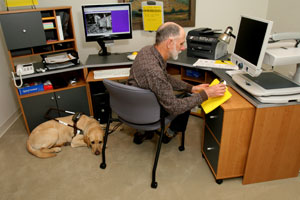
6:00am: Bob prepares breakfast and other tasks in the kitchen while getting ready for work. He asks that his guide dog, Fido, remain in a "down/stay" on his mat in the corner of the kitchen so Fido isn't underfoot.
7:00am: Bob and Fido set out for work which will require several bus transfers. They hop on their first bus and find it is super crowded today, so Bob chooses to stand. Fido is asked to remain in a "sit" by Bob's side. Fido must hold this "sit" position until the end of this ride because, if he lies down, he could get stepped on by the busy and distracted fellow riders.
8:30am: Before heading into the office, Bob and Fido stop at the drugstore. While Bob is standing in line, he needs Fido to hold a "stand" position as he isn't sure how long it will be until they will move forward to the counter.  Bob makes it to the counter and asks Fido to hold a "sit/stay" while he pays and maintaining this position also keeps Fido from helping himself to the crumbs on the floor.
9:00am: Bob and Fido finally arrive to work. Bob puts Fido on the tie-down beside his desk and Fido practices his "relaxation protocol" while Bob works.


As you can see, there are many times that it will be important for the dogs to have a good duration for all obedience. It's also super important that you never allow your dog to go into "relaxation protocol" without first releasing them with "break" from the command you last gave them!
 
How do you build duration?
Remember that when building one of the 3D's, you need to make the other D's easier in order to set your pup up for success. Because we are going to work on building duration, we will keep distance and distraction to an easy level.
  1. When building duration, start with an amount of time that you know with which your dog will be successful. For example, your pup can hold a "sit/stay" on a slippery store for 10 seconds.
  2. Practice the behavior, asking for "break" just before hitting your pup's limit for duration. In our example, we will ask our pup to "break" at 8-9 seconds.
  3. Praise and reward!
  4. Continue practicing with this duration for short period of time. So, let's say you spend 15 minutes in the store, walking around, and asking for a "sit/stay" 5-8 times, but making sure you release with "break" at 8-9 seconds.
  5. Return to practice or practice in similar situations with the same duration several times.
  6. Once your pup is very successful with that duration, practice with slightly more duration. In our store example, it's now a week later and we will ask our pup to hold the "sit/stay" for 10-11 seconds.
  7. Continue to build on duration for the different behaviors.


Troubleshooting
  • My puppy is breaking the position before I say "break." Your expectation of duration is too long and you need to make it shorter.
  • My puppy is able to hold the duration in a quiet situation, but not a busy situation. You will need to adjust your 3D's - your duration may need to be shorter if your distraction is higher.
  • Can I just say "break" right as I see my puppy break the position? No, this is not ideal. We want to tell the puppy when its acceptable to change positions or relax; we do not want it to be the puppy's idea.
 
Helping to extend your puppy's duration will prepare them for a stronger, more solid working career as a Southeastern guide or service dog! Stay tuned for our next entries on distance and distraction! 

Thursday, October 15, 2015

The Three D's: An Introduction

Over the next few months we will begin to explore what is commonly referred to in the dog training world as "The Three D's." The "D" stands for duration, distance, and distraction. When working with a dog in obedience, we build on all three throughout their training. Successful dogs will have had focused training for all three aspects of their obedience. Taking the Three D's into account ensures that you will be able to maintain a better connection with your pup! This connection will be critical in developing a relationship with your pup and "relationship centered training" is also something we will discuss in upcoming months.

Let's define the Three D's so you have a better understanding of what each entails.

  • Duration: This is the amount of time we ask a puppy to hold a position or do a behavior. 
  • Distance: This has two definitions. First, this is referring to the distance you and your puppy are in relation to a distraction, difficult environment, etc. Second, this can also mean the distance between you and your puppy, such as during a "come" exercise. 
  • Distraction: This is anything that takes your pup's focus away from you. Each dog will differ in what they find most distracting, but some common high distractions are other dogs, small animals, people, or items blowing/moving.


As a raiser, you may sigh when your pup doesn't perform the way you want during a puppy class and say, "But my puppy can do this at home!" However, you have to help your puppy do his obedience in every environment you come across so that your pup can generalize that a "sit" means "sit" no matter where you are or what's happening around you. The way we can help our pups is by adjusting the Three D's in order to allow your pup to be successful.

When working on one of the Three D's, you will want to make the others easier so that you are successful. For example, if you are working on holding a "sit" near another dog (distraction), then make sure you are only asking for a short duration and that your distance is not too close to the dog distraction.


Although we will be going more in-depth with each of the Three D's over the next several months, there is one important question you should start asking yourself any time you aren't sure how to reconnect with your puppy: "What can I change to make it easier for my puppy to reconnect with me - duration, distance or distraction?" This question will be the starting point for setting your pup up for success and helping them lead off on the right paw!

Wednesday, September 16, 2015

Walking with a Buddy!

Two common concerns I hear from puppy raisers are that they don’t have a fenced area to have play dates with other pups and their pups are very distracted at class because they are not allowed to play despite being right there with their friends. So what’s a raiser to do to help socialize their pup to other dogs? I really enjoy doing “buddy walks” with another dog when I don’t have access to allow the dogs to play off leash. This allows the dogs to check each other out and say “hello” from a distance, but keeps them moving and on a task.

A “buddy walk” is simply when two or more pups and handlers walk together. Below is a video of two handlers and dogs doing a buddy walk. There are some Dos & Don’ts for buddy walking, though.
  • DO start the walk by having some distance between you and the other dog. This could be each team on opposite sides of the road (or opposite sidewalks). If you have many raiser/dog teams, you may want to split up into smaller groups or pairs until the dogs start to settle in and the dogs are able to walk more closely.
  • DON’T start out directly beside each other, as it will be difficult to walk if the dogs are extremely distracted by each other in that close proximity.
  • DO use treat rewards once the dog is relaxed and staying by your left side.
  • DON’T worry about how bad the walking might look in the beginning. It will get better as time goes on and the dogs settle into the walk! Just keep walking and don’t make too many stops.
  • DO walk with other dogs in addition to Southeastern puppies. If you have a neighbor who would like to join you on a regular walks with their dog, its very beneficial for your pup to get used to being around dogs they don’t see at class and breeds other than Labs and Goldens.
  • DON’T allow your dogs to cross in front of you and greet each other while walking. You might need to keep your leash extra short, especially in the beginning. The point of this exercise is to just learn to be in the same space together; not to greet each other on leash.
  • DO plan on your walks being 30 minutes or more. This allows the pups to truly settle into walking together, which will lead to ending on a positive note.
  • DON’T get discouraged if it doesn’t go exactly as you planned. Remember to practice this often and you will find your dog settling into the routine more quickly.
  • DO these buddy walks at least 2-3 times a week to see real results. If you only do this once a month, your dog will not generalize as quickly that it should be settled when walking with other dogs.
  • DON’T focus on only walking very close to each other. Consider it a “success” if you were able to have the pups walk calmly, even if it was from a distance. Maybe next time your pups will be settle more quickly and be able to move closer!
  • DO use people without dogs in between the handler/dog teams. This provides a buffer if the dogs are very distracted by each other. As the walk progresses, the people without dogs can move to the outside of the group and allow the dogs to eventually get closer.


In the video, you will see two dogs practicing a buddy walk. Take note of how the handlers continue to walk even if their dog isn’t moving perfectly in the space. They also start out far enough apart that they are able to walk without their dogs being so distracted and excessively pulling or tripping the handlers. As the walk progresses, the teams start to walk in closer proximity to each other. You may notice that the dogs still pull a little, but eventually are able to walk even closer. As you advance your dog’s skills by making the situation more difficult, such as decreasing the distance between you and the distraction (the other dog), your dog will likely have a few minutes of adjusting to the difficulty. This is to be expected and you should not move closer until the dogs are connected to the handlers again. By the end of the walk, we are looking for nice, relaxed pups! 


By doing these buddy walks on a consistent basis, you should find a gradual, overall change in demeanor for your dog at class and other distracting situations. For our future guide and service dogs, practice of ignoring distractions will carry over into their work and help them be the superheroes we know they are!