

After last month's intro to the Three D's (3D's), we will be exploring each of the D's, in depth. This month, we are discussing DURATION and how to build on it. It's very important that our dogs have a significant amount of duration for all of their obedience behaviors by the time they come in for training. This allows our guide dog instructors to spend more time on teaching them new guiding skills and sharpening the obedience. However, if a dog comes in with very short duration, the guide dog instructor has to put more work into building it, instead of advancing them along.
Why is it important to build duration?
As guide dogs, our pups will be needed or expected to hold some positions for significant amounts of time while their handlers complete tasks. Let's build an imaginary morning for one of our guide dog teams where we see different examples of duration being used. We will call them Bob and Fido.
6:00am: Bob prepares breakfast and other tasks in the kitchen while getting ready for work. He asks that his guide dog, Fido, remain in a "down/stay" on his mat in the corner of the kitchen so Fido isn't underfoot.
7:00am: Bob and Fido set out for work which will require several bus transfers. They hop on their first bus and find it is super crowded today, so Bob chooses to stand. Fido is asked to remain in a "sit" by Bob's side. Fido must hold this "sit" position until the end of this ride because, if he lies down, he could get stepped on by the busy and distracted fellow riders.
8:30am: Before heading into the office, Bob and Fido stop at the drugstore. While Bob is standing in line, he needs Fido to hold a "stand" position as he isn't sure how long it will be until they will move forward to the counter. Bob makes it to the counter and asks Fido to hold a "sit/stay" while he pays and maintaining this position also keeps Fido from helping himself to the crumbs on the floor.
9:00am: Bob and Fido finally arrive to work. Bob puts Fido on the tie-down beside his desk and Fido practices his "relaxation protocol" while Bob works.
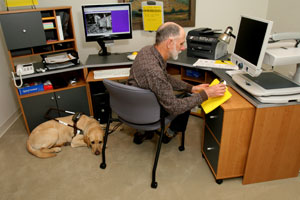
As you can see, there are many times that it will be important for the dogs to have a good duration for all obedience. It's also super important that you never allow your dog to go into "relaxation protocol" without first releasing them with "break" from the command you last gave them!
How do you build duration?
Remember that when building one of the 3D's, you need to make the other D's easier in order to set your pup up for success. Because we are going to work on building duration, we will keep distance and distraction to an easy level.
- When building duration, start with an amount of time that you know with which your dog will be successful. For example, your pup can hold a "sit/stay" on a slippery store for 10 seconds.
- Practice the behavior, asking for "break" just before hitting your pup's limit for duration. In our example, we will ask our pup to "break" at 8-9 seconds.
- Praise and reward!
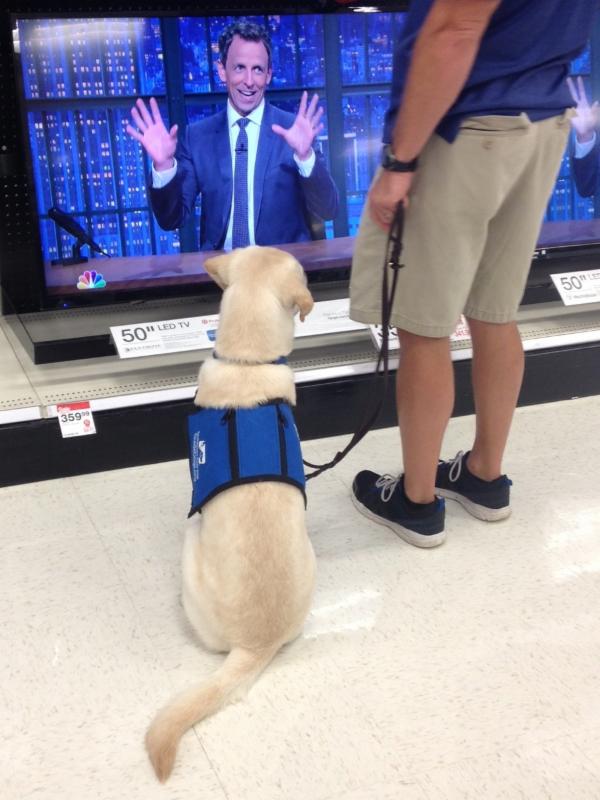
- Continue practicing with this duration for short period of time. So, let's say you spend 15 minutes in the store, walking around, and asking for a "sit/stay" 5-8 times, but making sure you release with "break" at 8-9 seconds.
- Return to practice or practice in similar situations with the same duration several times.
- Once your pup is very successful with that duration, practice with slightly more duration. In our store example, it's now a week later and we will ask our pup to hold the "sit/stay" for 10-11 seconds.
- Continue to build on duration for the different behaviors.
Troubleshooting
- My puppy is breaking the position before I say "break." Your expectation of duration is too long and you need to make it shorter.
- My puppy is able to hold the duration in a quiet situation, but not a busy situation. You will need to adjust your 3D's - your duration may need to be shorter if your distraction is higher.
- Can I just say "break" right as I see my puppy break the position? No, this is not ideal. We want to tell the puppy when its acceptable to change positions or relax; we do not want it to be the puppy's idea.
Helping to extend your puppy's duration will prepare them for a stronger, more solid working career as a Southeastern guide or service dog! Stay tuned for our next entries on distance and distraction!


